
Understanding how to play Indian Rummy at 5JL casino helps beginners quickly grasp the process of a game, from dealing cards, drawing cards from the face-down or discard pile, to discarding unnecessary cards. During gameplay at 5JL online casino, the main goal is to reduce the number of unwanted cards and complete the correct hand groups as quickly as possible.
The Most Detailed Guide to Playing Indian Rummy

Indian Rummy is a card game using two decks of 52 cards along with Joker cards. Each player is dealt 13 cards, with the main task being to arrange them into valid groups according to the game’s rules. During the game, you will continuously draw more cards and discard unnecessary cards to complete your hand.
The game ends when one player successfully arranges all 13 cards into valid groups and declares victory. The remaining players will have to reveal their cards to calculate their scores based on the cards that haven’t been arranged correctly. The player with the lowest score or who finishes their hand first wins that round.
Basic Rules and Game Objectives
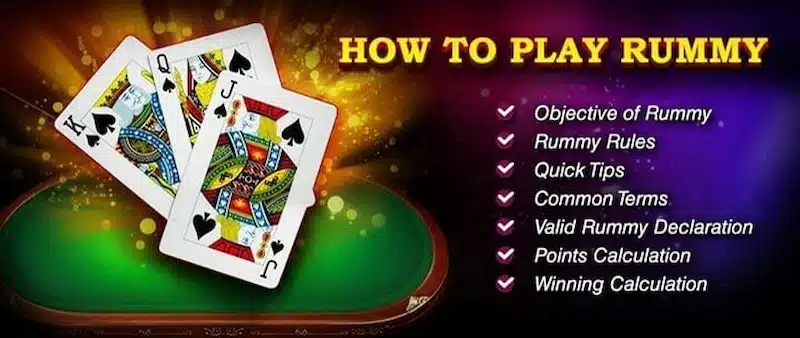
The main objective of each player in Indian Rummy is to arrange their 13 cards into valid groups before their opponents. Once the cards have been dealt into the correct groups, the player can declare victory to end the round. The basic rules include:
Number of players: Usually 2 to 6 people per table.
Number of cards: Each player is dealt exactly 13 cards.
Desks used: Two decks of 52 cards with Jokers.
Winning conditions: Players create at least two consecutive sets of cards of the same suit and other valid card groups from their 13 cards.
Valid Card Combinations in Indian Rummy
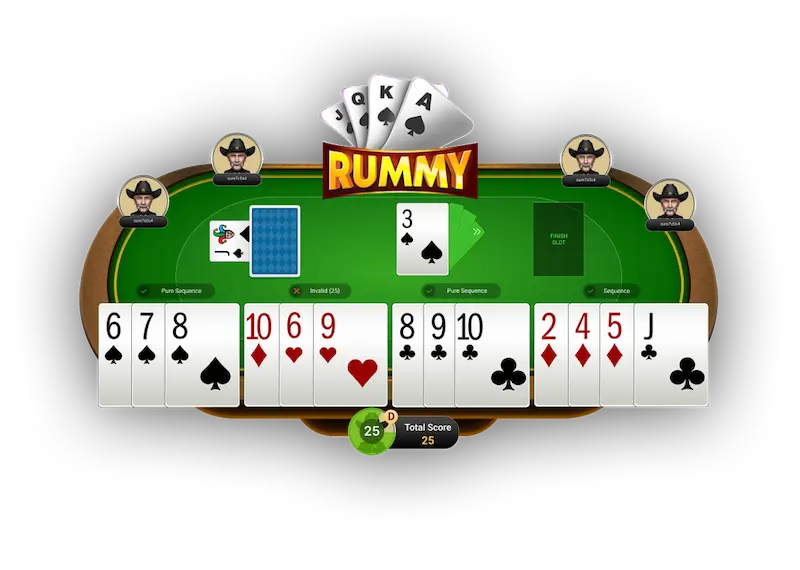
In Indian Rummy, cards must be arranged in consecutive sequences or groups of the same number. If cards are not in these valid groups, they will still be counted at the end of the game.
Consecutive sequence of cards of the same suit without Joker: This is a group of at least 3 consecutive cards of the same suit, for example: 5 of Hearts – 6 of Hearts – 7 of Hearts. Jokers cannot be used to replace a missing card in this group.
Consecutive sequence of cards of the same suit with Joker: This is a group of consecutive cards of the same suit, but a Joker can be used to replace a missing card. For example: 5 of Hearts – Joker – 7 of Hearts.
Group of cards of the same number but different suits: This is a group of 3 or 4 cards of the same value but different suits, for example: 8 of Spades – 8 of Hearts – 8 of Diamonds.
Joker Card: This can be a Joker already printed in the deck or any card chosen as the Joker in that game. The Joker card can substitute for many other cards to help complete card combinations.
The sequence of an Indian Rummy game
An Indian Rummy game takes turns, with players performing their actions until someone declares victory.
Drawing a card: A player can draw a card from the face-down deck or take a card that the previous player just discarded.
Discarding a card: After drawing a card, a player must discard an unnecessary card onto the face-up deck.
Arranging cards: Players continuously adjust the cards in their hands to form consecutive card sequences or groups of cards with the same number.
Declaring victory: Once 13 cards have been arranged into valid combinations, a player can declare victory to end the game.
How to calculate points at the end of a Rummy game
After someone declares victory, all remaining players must reveal their cards to calculate points. Points are calculated based on the cards that have not yet been arranged into valid combinations.
Cards A, K, Q, J: Each card is worth 10 points.
Cards 2 to 10: Points are calculated exactly according to the number on the card.
Incorrect declaration of victory: If a player declares victory but their hand doesn’t meet the rules, they will be penalized the highest penalty, usually around 80 points.
No valid consecutive hand: If a player doesn’t have at least one valid consecutive hand, all cards in their hand will be counted.
The best way to play Indian Rummy
Creating a consecutive hand of the same suit without using Jokers at the beginning of an Indian Rummy game will help players complete their hand more easily in subsequent turns. Completing this hand early significantly reduces the risk of being penalized with a high score if an opponent declares victory first.
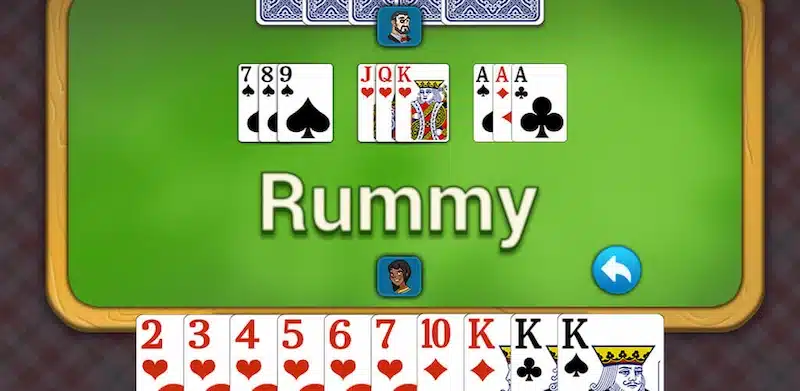
Prioritize keeping consecutive cards of the same suit
Pay attention to keeping pairs of cards with similar values, such as 5-6, 8-9, or 10-J if they are of the same suit, as adding one card at each end can complete a hand. Conversely, cards that are too far apart, such as 4-7 or 6-9, are often difficult to form a hand, so consider discarding them early to avoid taking up space in your hand.
Managing High-Value Cards
Cards like A, K, Q, and J usually have high point values, so holding them for too long without forming a sequence can result in significant penalty points at the end of the game. However, if they are close together and of the same suit, you can still keep them to form sequences like Q-K-A or 10-J-Q.
Observe Your Opponents’ Drawing and Discarding Habits
In online Indian Rummy, observing your opponents is a very effective way to know what kind of cards they need. If you see a player frequently drawing cards from the face-up deck, it may indicate they need cards of a value close to the one they just drew. In that case, you should avoid discarding cards of the same suit or with a similar number.